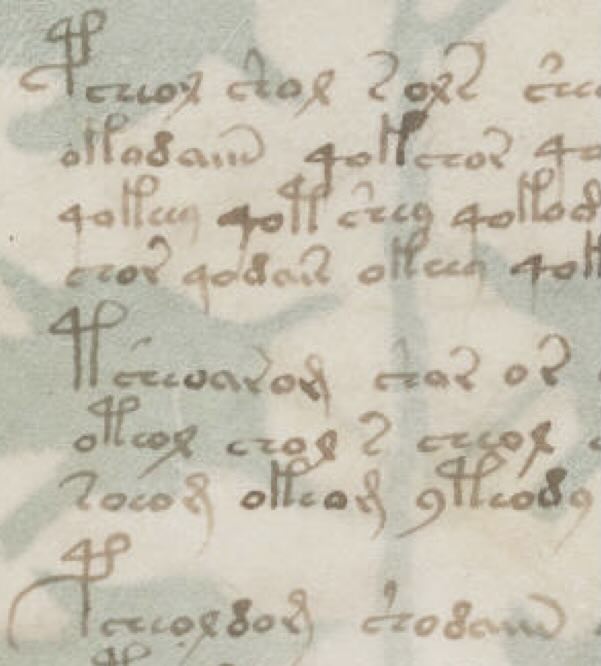
There is a very pronounced Alpha like letter. Which had some variant but common one resembles tear marks with eyes of the cheetah. Resemblence with Cheetah's face may sound speculative but this letter clearly stand outs like the letter alpha from other scripts. And strokes of this letter resembles modern A, P, L letters and as a whole it looks like H letter.
Another crazy thing is that I published that the word "crypt" originates from phoenician letter alpha because it looks like an eyelash (kirpik in Turkish). And blinking is from same root kırp-. For instance “blinked” is “kırp+tı”. Well, One of the most common variant of this Alpha letter from Voynich Manuscript looks like just left eye closed. It is also probably important to point out that “Crypt” starts with “Cry”. And it is a crypted text. The legs of this Alpha letter corresponds to tears marks of a cheetah. Kinda sounds like too much of a coincidence. Obviously none of these originates from this text. It is just the writer was aware of this stuff.
It is a possibility that letters can be translated to kufic letters 1 to 1. As anybody who is familiar with kufic script can spot resemblance instantaneously.
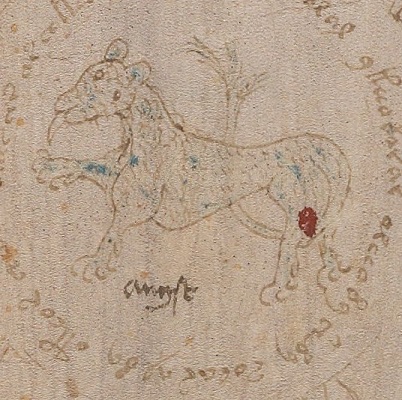
There is an animal depiction that is possibly a cheetah (*) but there aren't anything like tear marks under its eyes and its head is kinda weird. Weirdist part is its tongue which looks very sharp. In Turkish tongue is “dil”. It also a verb for splitting. Also there is a red splash on its back which looks like random. The color red not usually referred by it but in Turkish “Al” means red for some readon. Like Turkish flag is called “Al Bayrak” (Red Flag). I independently from this suggest Turkish word for cheetah is actually constructed as “Al+Pars+lan”. These are kinda nice coincidences but it is not really possible to go anywhere with. If this animal is actually a cheetah. This actually makes me reconsider whether the stuff with Alpha like letter was intended. Although it doesn't change the fact that coincidences kinda pile up. Around the chin of head of cheetah drawn weirdly. Kinda confusing. According to the article the depiction it is being part of relates to month of August. (Well, this one is probably clear based on astrology signs. Although it seems like normally August is not associated with cheetahs. But this August is not reallly surprising.)
Also the word for tongue also means language in Turkish similar to how it is many other languages for obvious reasons. Maybe author is trying to make a direct connection with Turkish over the tongue. Speculation goes lion was sometimes avoided as zodiac sign because of a sentence from bible but I can't say it makes sense. It seems like it is unique case of cheetah is being used as a zodiac sign of August. Judging it lacks tear marks. It should be a generic leopard.
(Cats has countless sharp hook-like projectiles on their tongue.)
Obviously. There is a statistically meaningful situation here. And these were first things I realized and looked for. Although it is not clear the animal in the depiction is a cheetah because in this context I think tear marks are distinctive. Still cheetah is almost non-existent outside of very narrow geography. (Islamic, Persian, Egyptian literature) Also depictions are very ridiculous. There are naked womans everywhere. I think obviously they are there to defer suspicions. I think texts suspected to be Turkic were seized in Europe. And it is even possible that it is just canonical Quran. Although not saying this seriously. Just as a possibility.
I have watched a video about how it just can be hoax based on some patterns and statistical differences between common languages. Actually similar patterns was confusing me about Quran. But it just doesn't indicate a hoax. Simply because it doesn't have to be adhere statistical patterns of modern languages. Like how words with single letter difference distributed close to each other. This actually make sense in case of Turkish but not most of the modern languages. For instance, a Turkish sentence: "Marketten elma alabilir de almayabilir de." . Means: He can buy apple from market or he may not. The words "alabilir" and "almayabilir". When written in modern Turkish the negated one has three characters in the middle. And this is likelly to be happen frequently. And in case of this script the negation suffix may correspond to just one character. I haven't examined it throughly. I may never. But probably this is the reason why it is frequently claimed to be a Turkic text.